
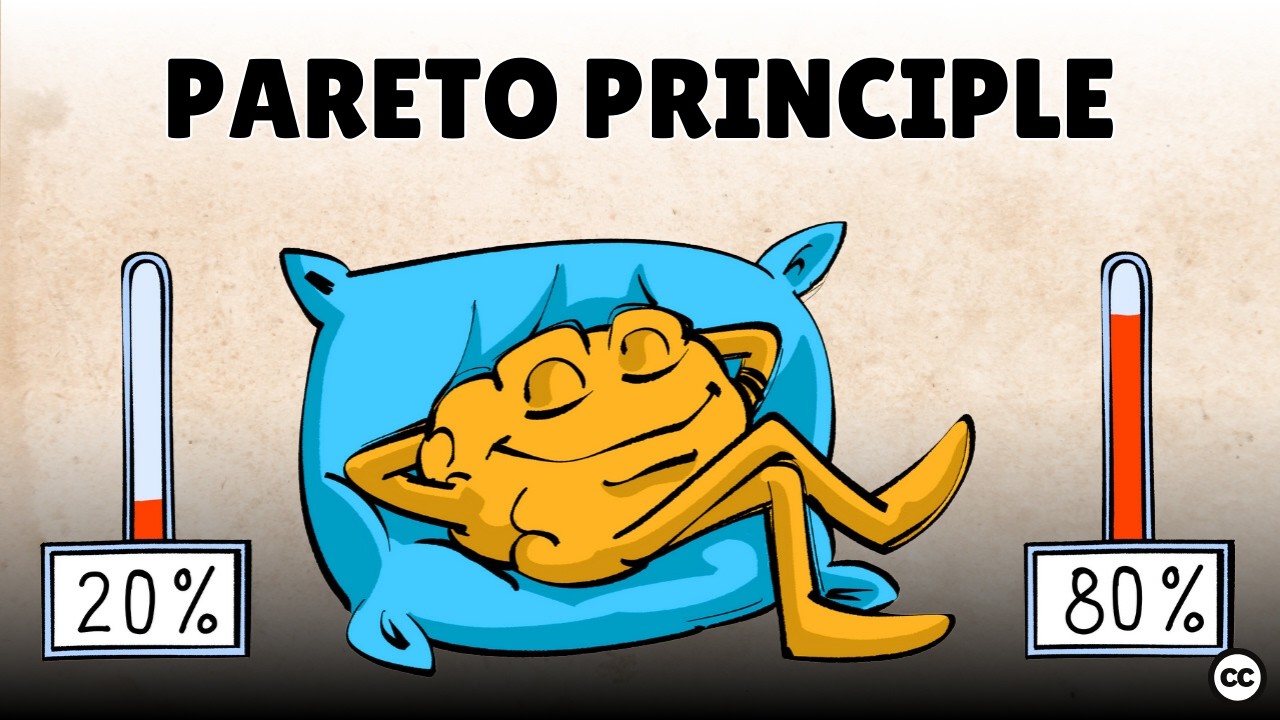
The Pareto Principle, also known as the
80/20 rule, states that often 20% of the causes create around 80% of the outcomes while the
remaining causes are responsible for the rest. Or, as a simple rule for self-help: 20% of
your effort makes up 80% of your success. The principle was discovered by the
Italian economist Vilfredo Pareto, who first realized that 20% of the pea pods in his
garden were responsible for 80% of all the peas, and then that 80% of all the land in
Italy was owned by just 20% of its people.
Over time, the principle became a valuable rule
of thumb that allows our mind to understand all sorts of complex distributions, focus on the
essentials, and prioritize what to do next. Business owners, for example, often realize that
about 80% of a company's income comes from just 20% of the customers, and as a result,
know who to give special attention to. Constructors who find out that 20% of the
hazards result in 80% of the injuries, can take important precautions to eliminate risks.

And software engineers who know that fixing the
top 20% of the most-reported bugs eradicates 80% of errors, can spend their time on these top 20
and let the other 80% continue bugging people. However useful the rule may be, Pareto
himself warned against relying too much on the principle when he said: “Men follow
their sentiments and their self-interest, but it pleases them to imagine
that they follow reason. And so they look for and always find some theory
which, a posteriori, makes their actions appear to be logical.
If that theory could be demolished
scientifically, the only result would be that another theory would be substituted for
the first one, and for the same purpose.” What do you think of the 80/20 rule? Where
can it be applied? And where do we need a more thorough analysis to fully understand what’s
going on? Share your thoughts in the comments below! But beware: 20% of the responses
might make up 80% of the conversation. If you like this video and want us to make more,
subscribe to our channel or support us on Patreon..